

AI-Driven Dynamic Pricing: When Does Efficiency Become Exploitation?
By Riya Patel, Northeastern University

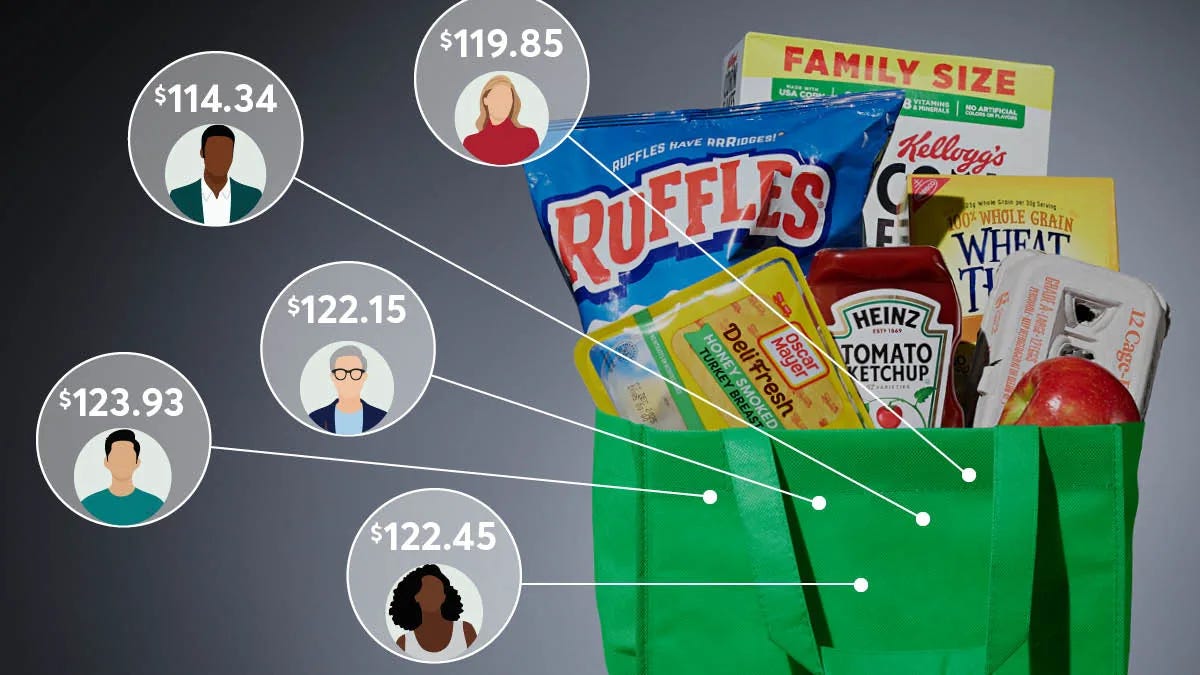
Your online grocery cart has the same items in it every week, yet you’re always paying different prices. For the same exact product. This isn’t a glitch, and it’s not related to inflation. This is the result of AI-driven surveillance pricing, a practice in which companies use personal data about consumer behavior and demographics to estimate each consumer’s maximum willingness-to-pay and use that to set their prices.
People associate surveillance pricing and dynamic pricing as the same, when they’re not. Dynamic pricing, like airline fares or concert tickets, operates on supply and demand. If more people want the product, the pricing will automatically go up to accommodate the demand; if not, the price will decrease. While controversial, it at least follows market logic that is visible to consumers. Surveillance pricing operates differently. It has nothing to do with market conditions and everything to do with the individual consumer.
As these systems become more advanced and more embedded in everyday commerce, this practice raises questions about consumer data privacy. The question is no longer whether surveillance pricing exists, but whether companies should be allowed to use personal data that consumers never consented to share to determine what they pay.
The Slow Creep of Surveillance Pricing
Dynamic pricing is not a new concept. After the Airline Deregulation Act of 1978, U.S. airlines gained full control over their own fares for the first time. American Airlines took full advantage, developing DINAMO, a Dynamic Inventory and Maintenance Optimizer, in 1986. The system used data from American’s existing reservation infrastructure to identify patterns in customer booking behavior and automatically adjust prices at the micro-market level. It was one of the first times a company used technology to practice price discrimination at scale, and it worked. The system generated an additional $500 million in revenue without adding a single flight.
Through the 1990s, the practice expanded across industries into hotels, car rentals, and rail service. The underlying logic made sense: prices should shift in response to demand, if more people want the goods, it makes sense to charge higher prices.
The early 2000s marked a turning point in how companies could price goods. Digital commerce was maturing, and Amazon began experimenting with behavior-based pricing, exploiting the fact that price changes online could happen instantly and invisibly. Then, in 2012, Uber popularized surge pricing on a mass scale, automatically raising fares based on driver availability, weather conditions, and time of day. Jay Stanley from the American Civil Liberties Union notes, this form of pricing is still different from surveillance pricing: “It’s different from charging more for an umbrella when it’s raining. It’s different from Uber charging different prices at different times of day depending on the amount of demand”. The key difference is that traditional dynamic pricing responds to the market; surveillance pricing responds to data about you.
The gap between dynamic and surveillance pricing is closing fast with the rise of AI. Companies are actively integrating advanced AI into their pricing systems, allowing them to shift from broad demographic assumptions to individual targeting. They take into account a user’s browsing history, location, device type, time spent viewing a product, and more. It is this transition that has moved the practice from competitive strategy into an ethical gray area.
The Profit Motive
Supporters of AI-driven pricing often frame it as a tool that makes the market for goods more efficient, arguing that prices reflecting real-time conditions would benefit both producers and consumers. A McKinsey study found that AI-based pricing systems can increase company revenue by up to 8%. Delta Airlines is already testing a new AI “super analyst” with the explicit goal of maximizing revenue. They plan to use it to set up to 20% of its domestic fares.
Delta denies using personal data to set prices, but this practice raises lawmakers’ concerns about where this technology is headed. What if the system could detect that a customer was traveling home for a funeral and charge them accordingly? “Prices could be dictated not by supply and demand, but by individual need,” three U.S. senators wrote to Delta’s CEO in July 2025. This isn’t just an efficient way to do business; this is an extraction tool.
The Same Product, A Different Price
A Consumer Reports investigation found that AI-driven pricing on Instacart caused prices to vary by 23% across users, with 74–75% of products carrying different prices depending on who was buying. Grocery stores, like Target, have also been found setting prices based on ZIP codes rather than product demand. This disproportionately burdens lower-income communities, where competitive alternatives are limited and hard to reach.
A 2025 study from Carnegie Mellon University’s Tepper School of Business, published in Marketing Science, found that the problem goes beyond individual price changes. AI is not just setting prices in the background. It uses algorithms to reorder products shown to you, based on your browsing history, to surface what you are most likely to buy.
When a platform personalizes the order products appear in, shoppers stop comparing options. They are shown what they are most likely to buy, so they simply buy it. These systems don’t just change prices; they change how you shop. By limiting comparison and tailoring options, they reduce price sensitivity and increase the likelihood of purchase. Over time, this shifts consumers from active decision-makers to passive participants in a curated buying experience. Sellers no longer have to compete on price to find buyers, and prices rise for everyone as a result. You do not have to be directly targeted for AI pricing to cost you more.
Using Your Data for Their Advantage
Surveillance pricing gets more predatory when you see what data is actually being tracked. Companies have been found factoring in browsing history, geographic location, time spent on a product page, battery percentage, and device type when setting prices. Business Insider found that iPhone users are typically charged more service and delivery fees on DoorDash than Android users for identical carts, based on the assumption that iPhone ownership signals greater purchasing power. For instance, an independent study, later covered by a Belgian newspaper, found that Uber may charge up to 6% more when a user’s phone battery fell below 15%, a claim Uber denies.
None of this data was volunteered. Consumers have no idea it is being used, no way to opt out, and no knowledge that the price they see was calculated specifically for them. The legality of this strategy isn’t clearly defined. Jay Stanley, a senior policy analyst at the ACLU calls it ‘a bit of a legal gray area,’ touching state privacy laws, civil rights protections, and federal consumer protection law.
The Industry Case for AI Pricing
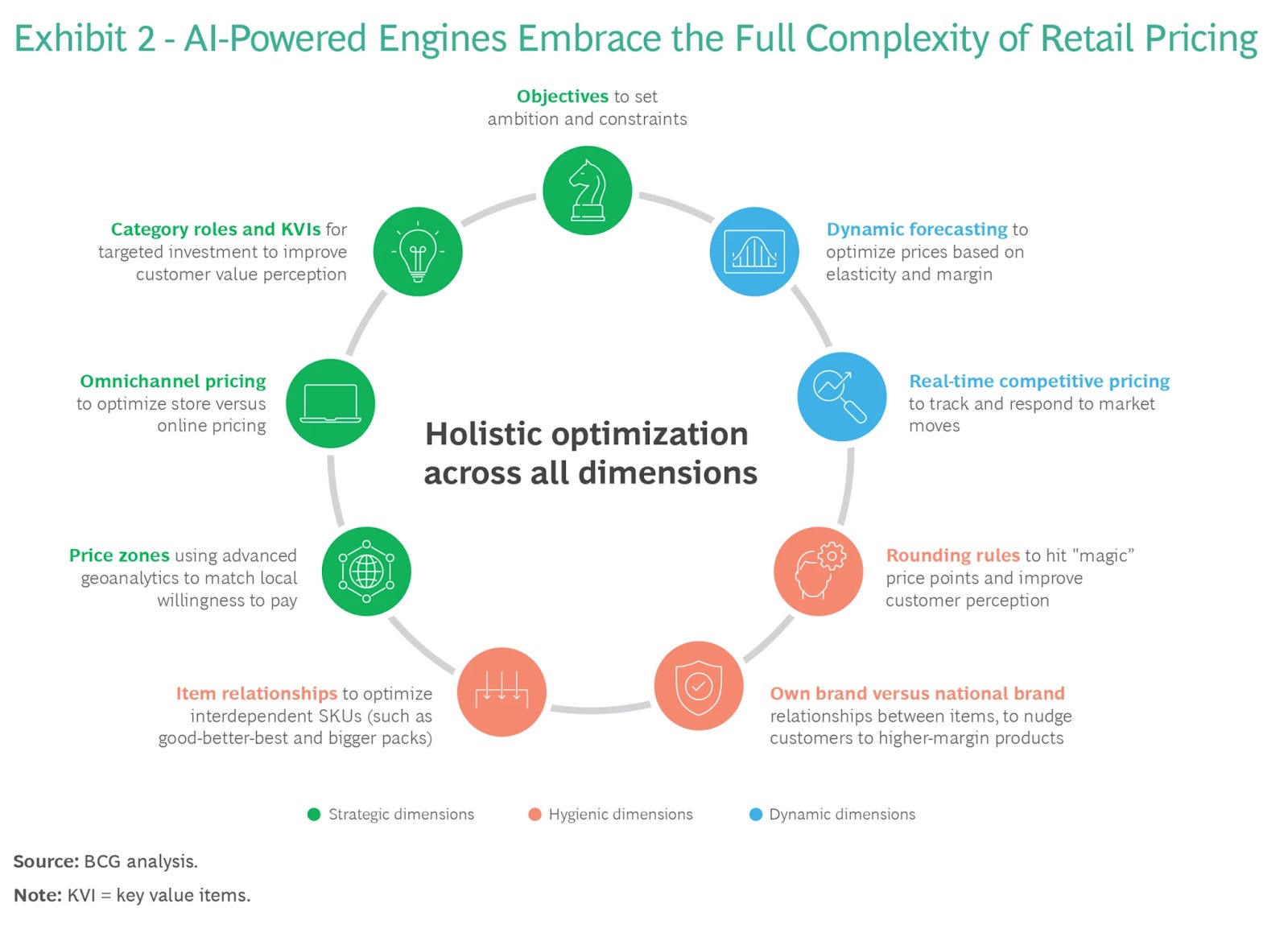
(BCG’s framework for AI-powered retail pricing optimization. Source: BCG Analysis.)
Companies do not implement AI pricing arbitrarily. They do it to keep up with competitive pressure. In a recent report by Boston Consulting Group, they actively advise retailers to treat AI pricing as a strategic necessity. They report that retailers using AI pricing have increased gross profit by 5–10%, framing the technology as a tool that helps companies invest more precisely in what consumers actually want.
It is worth acknowledging that companies are not operating in a vacuum. With the current political climate causing rising costs, supply chain instability, and thin margins, these pressures are inevitable. Any tools that help businesses stay competitive and keep prices aligned with market conditions are logical to use. Not every component of AI pricing is predatory. Real-time competitive tracking and demand forecasting have genuine value. But the problem is not the technology itself. It is how far it has gone.
The Long Game
Companies implementing surveillance pricing are betting on short-term margin gains. But the math does not hold up over time. According to a Clutch report, 97% of consumers say a brand’s authenticity influences their purchasing decisions, and 87% say they would stop supporting a brand whose actions violated their values. Secretly charging customers different prices for the same product based on personal data they never consented to share is exactly that kind of violation. When consumers find out, and they increasingly are, they have no problem leaving.
The problem is that replacing a lost customer is expensive. A Forbes study found that acquiring a new customer costs five to seven times more than retaining an existing one. A 5% increase in customer retention, on the other hand, can grow profits by anywhere from 25% to 95%. Loyal customers also spend 31% more than new ones and are 50% more likely to try new products. The marginal revenue gained from surveillance pricing does not come close to offsetting the cost of losing the customers it alienates.
Surveillance pricing is a short-term extraction strategy with long-term consequences. Companies are trading customer trust for a few extra dollars per transaction, in a market where consumers have more options and less loyalty than ever before.
Who Is Protecting the Consumer?
A frequent Instacart user could see price swings of roughly $1,200 per year because of surveillance pricing, and most of them have no idea it is happening. New York was the first state to respond, passing a law in 2025 requiring retailers to post a clear disclosure: “THIS PRICE WAS SET BY AN ALGORITHM USING YOUR PERSONAL DATA.” Many people are not satisfied with this regulation. Consumer rights groups say the law does not go far enough, and business groups say it goes too far. But for the first time, a state is paying attention.
Senator Kirsten Gillibrand of New York wants to go further. Her proposed One Fair Price Act would make it illegal for companies to use your personal data to charge you more than someone else for the same product but the federal government is moving in the opposite direction. The agency responsible for protecting consumers from unfair business practices, the FTC, recently dropped its investigation into surveillance pricing entirely. The individuals pushing for change are doing it without federal backup. Former FTC Chair Lina Khan, who started that investigation, warned that surveillance pricing is threatening to ‘fully creep across the economy.’ For now, the regulations are being left to individual states, and most consumers have no idea it is even happening.
What Comes Next
Surveillance pricing is often framed as a technological problem; however, at its core, it is a trust problem. The entire model depends on consumers not knowing what is happening to them. The moment they find out, and increasingly they are, the math stops working.
The companies that will win long term are not the ones extracting the most from each transaction. They are the ones that consumers trust enough to keep coming back to. In a market where switching costs are low and options are endless, loyalty is the only sustainable advantage. Surveillance pricing is an effective strategy to generate more short-term revenue, but it has nothing to do with what actually drives long-term business success: customer satisfaction and retention.
 | A guest post by
|