

How Working Hours Shape Productivity: Corporate, Legislative, and Academic Perspectives
By Simon Sales, University of California—Los Angeles

The Industrial Myth vs. Modern Reality
The relationship between productivity and the number of hours we work has long been treated as a matter of common sense: more hours mean more output. This belief is so deeply embedded in workplace culture that it often goes unquestioned. Yet as I examined the data behind how productivity actually behaves, both historically and in contemporary labor markets, the story becomes far more complex. The evidence increasingly suggests that productivity is not a direct product of time spent working, but rather a function of how human beings operate within the limited cognitive, emotional, and physiological bandwidth we possess.
This disconnect between intuition and reality is not a new phenomenon. Historically, the idea that longer hours equate to higher productivity emerged during the industrial era, when output was tied to machinery that could run continuously. In that setting, extending the workday produced tangible gains. But as economies shifted toward knowledge-intensive industries, creativity, analysis, and decision-making became the primary drivers of value. Even then, organizations continued to cling to the long-hours model, despite early signs that it was incompatible with the demands of modern work.
The Evidence: Diminishing Returns and Economic Trends
Today, the data is clear: productivity has diminishing returns beyond a certain point. Analyzing international labor and productivity indicators, I found a consistent negative relationship between the number of hours worked per year and the value generated per hour. This aligns with decades of academic findings across sectors and regions, like data consistently shows:
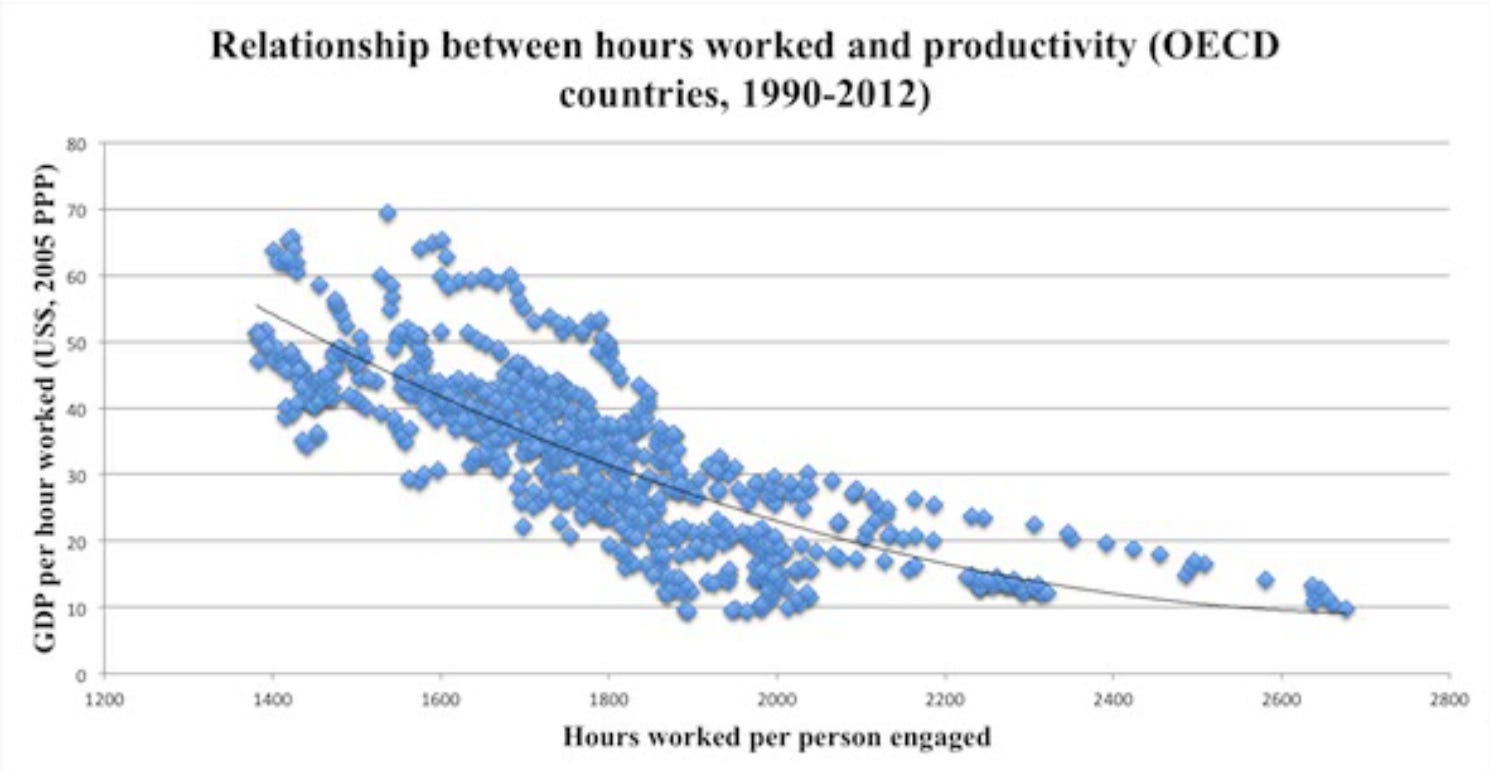
Source: OECD
The evidence converges around a simple but consequential truth: humans are most productive in a window of roughly six to eight hours of focused work, and beyond that, the quality of output declines sharply. From the ninth hour onward, efficiency falls to nearly half of its earlier levels, with error rates and cognitive fatigue rising in parallel.
Even industries that rely on precision confirm this pattern. Studies of nurses show that shifts extending to twelve hours significantly increase mistakes as these shifts are associated with a 30–40% increase in error probability, directly impacting patient safety. Similarly, analyses of manufacturing and call centers reveal that after a certain threshold, additional hours no longer translate into proportional gains due to inefficiency and compounding mistakes. The cognitive load required for sustained, error-free performance simply cannot be stretched indefinitely. (Rogers, A. E.)
This growing body of scientific evidence has led many governments to reconsider how they legislate working hours. Across the OECD, shorter workweeks have become the norm, and several countries are piloting four-day models without reducing salaries. These policies are not ideological experiments; they are economic strategies rooted in empirical findings. OECD data shows that countries averaging 1,400–1,700 annual working hours consistently outperform those exceeding 2,100 hours in hourly productivity. When nations reduce excessive hours, they typically see improvements in productivity, employee well-being, retention, and innovation-core drivers of long-term competitiveness. (Luxton, E.) Data comparing labor productivity for individual nations supports this logic, showing that even when short-term productivity dips due to hour reductions, natural productivity growth driven by technology, training, and operational improvement offsets those losses over time. For instance, in Colombia, where some of the longest workweeks coincide with comparatively low productivity per hour, recent labor reforms have reduced the legal working hours and, even when slightly reducing productivity initially, have led to major benefits in terms of burnout reduction, employee satisfaction, quality of life, and even hourly productivity growth. (Pencavel, J.)
A New Paradigm: Applying the Science of Focus
Beyond legislative and corporate spheres, these insights also carry meaningful implications for students. For many of us, especially those preparing to enter demanding professions, the instinct is to equate long study sessions, late nights, and marathon work blocks with effectiveness. But the same principles that apply to national labor markets apply to our academic and professional lives. The hours we spend working do not scale linearly with what we learn or produce. Past a certain point, diminishing returns take over. We reread the same lines without absorbing them, make avoidable mistakes, or lose the clarity needed for complex thinking.
Understanding the structure of productivity allows us to make better choices. It enables us to design daily schedules that align with how the brain actually performs. It encourages us to protect rest, leisure, and sleep as legitimate components of efficiency. And it teaches us to define hard work not by the number of hours we sacrifice, but by the focus and quality we bring to the hours that truly count.
As future professionals, policymakers, or leaders, we have the opportunity to reshape the culture of work we will inherit. The evidence shows that sustainable productivity-whether at the level of a corporation, a country, or an individual-is not about pushing human limits but about respecting them. If we want to create careers that are both fulfilling and effective, the path forward begins with a simple shift in mindset that some might regard as a cliché: work smarter, not harder.
References
Luxton, E. (2016, March 4). Does working fewer hours make you more productive? World Economic Forum. https://www.weforum.org/stories/2016/03/does-working-fewer-hours-make-you-more-productive/
Pencavel, J. (2015). The productivity of working hours. The Economic Journal, 125(589), 2052–2076. https://doi.org/10.1111/ecoj.12166
Collewet, M., & Sauermann, J. (2017). Working hours and productivity. IZA Discussion Paper No. 10722. Institute of Labor Economics.
Dolton, P., Howorth, C., & Abouaziza, M. (2016). The optimal length of the working day: Evidence from Hawthorne experiments. Royal Holloway, University of London.
Rogers, A. E., Hwang, W.-T., Scott, L. D., Aiken, L. H., & Dinges, D. F. (2004). The working hours of hospital staff nurses and patient safety. Health Affairs, 23(4), 202–212.