

When Oversight Becomes Control
By Youssif Shaker, Northeastern University

U.S. universities have long operated with institutional independence. A wave of federal and state pressure is now testing where accountability ends and political control begins.
For most of American history, the relationship between government and the university rested on a quiet bargain: public money in exchange for public benefit, not public obedience. Governments funded research and student aid; universities produced knowledge, trained citizens, and managed their own affairs. Faculty hired faculty. Tenure protected scholars from political whim. Accreditors set standards independent of whoever happened to hold office.
Today, that arrangement is under strain. Since 2023, federal and state governments have moved beyond compliance enforcement into territory that critics say resembles direct institutional control: dictating who can teach, what can be studied, how campus demonstrations are managed, and which administrative offices are permitted to exist.
The question at the center of this debate remains: Can the government hold universities accountable for how they spend public money without also determining how they think?
The Board and the Classroom: New College of Florida
New College of Florida is a study in political control over a university. The small liberal arts college in Sarasota had, prior to 2023, a national reputation for progressive pedagogy and a strong LGBTQ+ community.
In January of that year, Governor Ron DeSantis appointed six new members to the college’s 13-member board of trustees, enough to swing its ideological direction in a single meeting. The board quickly voted to eliminate the college’s diversity, equity, and inclusion office. It abolished the gender studies program, with books from the shuttered Gender and Diversity Center removed from shelves. The board fired the college’s first female president and replaced her with a former Republican State House speaker.
In April 2023, the newly constituted board denied tenure to all five applicants who came before it, despite each having been approved at every other level of the process, including by the acting president. The American Association of University Professors (AAUP) called the denials a violation of its recommended procedures. The faculty trustee resigned in protest immediately after the vote.
“Academic freedom, shared governance, and respect for mutually approved processes have been thrown under the bus by the new trustees.” — Irene Mulvey, AAUP President, 2023
By the end of 2023, more than a third of the faculty, roughly 36 professors, had left the institution. Another 12 departed in 2024. The AAUP’s governing council voted unanimously to sanction New College over noncompliance with shared governance standards. Come late 2025 , the college publicly volunteered to be the first institution to adopt the Trump administration’s higher education compact, a document most other universities declined to sign, citing academic independence concerns.
New College is an extreme case. But it illustrates the mechanism clearly: when a governor controls trustee appointments, and those trustees control hiring, tenure, and curriculum, the line between governance and political direction disappears.
The Federal Lever: Funding as Pressure
At the federal level, the primary instrument is the research funding relationship. American universities depend on federal grants, particularly from the NIH and NSF, for scientific research. That dependence creates leverage that the Trump administration has been willing to use.
The first major test came at Columbia. In March 2025, the Departments of Justice, Education, Health and Human Services, and the General Services Administration jointly canceled approximately $400 million in federal grants and contracts to Columbia University, citing the school’s alleged failure to protect Jewish students from antisemitism on campus following the 2024 pro-Palestinian demonstrations.
FEDERAL FUNDING ACTIONS — UNIVERSITIES, 2025–2026
Institution
Funding Action
Outcome
Columbia University
March 2025
$400M canceled
Settled; $220M payment + governance concessions
Harvard University
April 2025
$2.2B frozen
Sued; court ruled freeze unconstitutional (appeal pending)
60+ Additional Universities
2025
Under review
Enforcement threat letters sent by Dept. of Education
Columbia initially stated they would collaborate with the government to address the cancellation. By July 2025, the University had agreed to a settlement paying over $220 million to the federal government and accepting changes to its disciplinary processes, campus security protocols, and oversight of some academic programs. Among the most controversial terms, Columbia agreed to share disciplinary records of student visa holders who were expelled or suspended with the federal government. Dozens of students who participated in campus demonstrations were subsequently suspended or expelled.
Columbia’s capitulation set a precedent that Harvard chose not to follow.
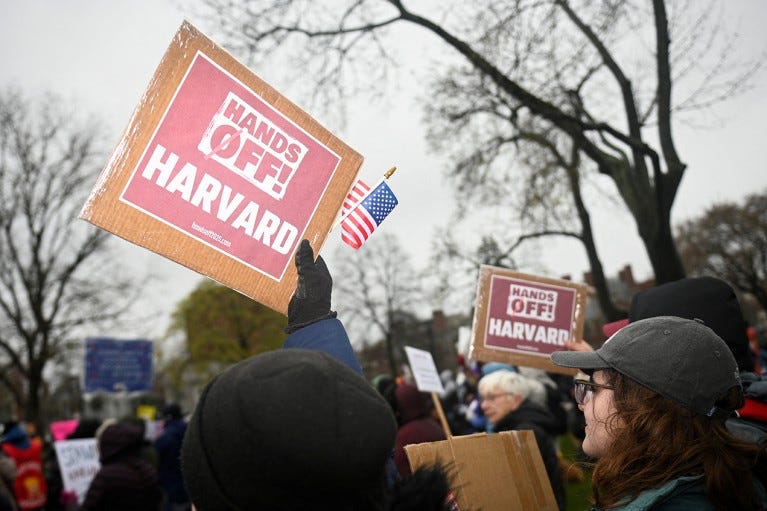
In April 2025, after Harvard’s president publicly rejected White House demands, which included audits of academic programs, changes to governance structure and hiring practices, and reviews of faculty and student viewpoints, the administration froze more than $2.2 billion in research grants. The freeze halted work across medicine, engineering, and the life sciences, including a $60 million tuberculosis research consortium and a $10 million coronavirus preparedness project.
Harvard sued the federal government rather than negotiate. In September 2025, a federal district court judge ruled that the funding freeze violated the First Amendment, finding that the administration had impermissibly retaliated against Harvard for protected speech, specifically, its public refusal to comply. The Trump administration appealed in December 2025; the case remains ongoing.
“No government — regardless of which party is in power — should dictate what private universities can teach, whom they can admit and hire, and which areas of study and inquiry they can pursue.” — Harvard President Alan Garber, April 2025
The Chilling Effect
Harvard and Columbia both illustrate the stakes of resistance. What may be more consequential is what happened at institutions that never made the news, schools that quietly changed policies, softened positions, or pre-empted demands to avoid becoming the next target.
The American Council on Education (ACE), the principal lobbying group for higher education, warned that the Columbia funding cuts set a dangerous precedent precisely because they bypassed the legal procedures designed to govern such actions. Under Title VI of the Civil Rights Act, the Department of Education’s Office for Civil Rights is responsible for investigating discrimination complaints and imposing sanctions through a defined process. The administration’s unilateral decision to cancel grants circumvented that process entirely, creating a climate where any university could face sudden financial punishment without formal investigation or due process.
“You don’t get to punish people just because you don’t like what they’re doing,” ACE’s senior vice president for government relations told Inside Higher Ed at the time.
An analysis published in early 2026 found that even after Congress maintained research funding levels, federal agencies made fewer grants in 2025 than in prior years. The grants that were made tended to be larger and more competitive, effectively giving the administration more discretion over which research projects to favor. Researchers who study politically sensitive topics face an uncertain funding environment even when their work hasn’t been directly targeted.
Where Oversight Ends
None of this is to say that government oversight of universities is inherently illegitimate. Universities receive enormous public subsidies. Civil rights law applies to them. There are genuine concerns about antisemitism, about the quality of research, about administrative bloat and the rising cost of tuition — that merit serious policy responses.
The distinction that matters is between oversight designed to enforce law and oversight deployed to reshape ideology. Federal research security requirements, disclosure rules for foreign funding, conflict-of-interest reporting, and oversight are intended to promote integrity. They do not tell researchers what conclusions to reach. Similarly, a formal investigation into specific civil rights complaints, conducted through established legal processes, is an act of accountability. It is not the same as freezing billions in research grants as a negotiating tactic over governance disputes.
The pattern emerging from the 2025 actions suggests something closer to the latter. The demands Harvard received, audits of faculty and student viewpoints, changes to governance structure, and oversight of hiring went far beyond anything Title VI requires or authorizes. The court said as much in September. What distinguished Harvard’s outcome from Columbia’s was not the strength of the legal position; both schools faced the same leverage. What differed was the willingness to absorb the cost of resistance.
Anticipated Direction for 2026
The Trump administration’s approach has shifted since the most aggressive confrontations in 2025. As universities won in court and others held firm, the administration moved away from dramatic bilateral funding freezes and toward more structural tools: changes to student loan eligibility, new rules at the Department of Education, and caps on graduate-level federal borrowing embedded in the 2025 tax and spending legislation.
These are slower mechanisms, but they may ultimately be more durable. They operate through legislation and rule-making rather than executive order, giving them a stronger legal footing and broader reach. A cap on graduate student borrowing affects every doctoral program in the country; no lawsuit can undo it as easily as a federal judge can block a funding freeze.
The core question, how the U.S. holds universities accountable for public funding, civil rights obligations, and institutional integrity without allowing oversight to harden into political control, has not been resolved. It has only become more urgent. The answer will shape not just what happens on campuses but also what kinds of knowledge American institutions can produce and for whom.
 |
|